The Ministry of Transportation has released a draft report entitled “Highway 413 Preliminary Design and Assessment of Environmental Impacts” for public comment. The document is large – 1700 pages. Transport Action Ontario has submitted comments in two areas:
Species at Risk are in grave jeopardy. Impacts from highway will contravene federal objectives. This comment is based on two recent expert reports commissioned by Environmental Defence Canada – on the red side dace and the western chorus frog.
Scope of report is too narrow. A re-evaluation of alternatives to the undertaking would show that transit is a better alternative than Highway 413. This comment is based on the recent joint report published by Transport Action Ontario and Environmental Defence Canada entitled “Transit over Traffic: Hard Truths for Addressing Gridlock in the GTHA”
Transport Action Ontario and Environmental Defence Canada have jointly published a major report on addressing gridlock in the Greater Toronto and Hamilton Area (GTHA). It makes the case that spending $80 billion on mega-highways like Highway 413 and the Highway 401 tunnel will make commutes worse, not better. Decades of experience across North America show that expanding urban highways (non-tolled) just induces more traffic. For the same $80 billion price tag, Ontario could build 400 km of new rapid transit.
The report makes the case that the best way to reduce gridlock is to reallocate highway funding to transit builds and also double transit service so people can “show up and go” without checking schedules. Cities where 30% of rush hour trips are by public transit have proven that this approach works to ease road congestion.
The report also uses Highway 413 as a case study – and demonstrates that putting $14 billion (the estimated capital cost of this highway) towards public transit investment instead of the highway would move more than double the number of commuters per hour.
The report recommends 5 bold actions:
Redirect capital funding from mega-highways to transit
Increase transit operating funding
Reverse car-enabling subsidies
Reduce tolls on Highway 407 for trucks as part of a region-wide road pricing scheme
Transport Action Ontario has sent a letter to the three First Nations that are leading the environmental assessments (EAs) on construction and operation of a gravel access road to the Ring of Fire. Our letter urged that the EAs include a heavy-haul rail line in the rail corridor, due to the strong business and social case.
The deep need in Toronto for better transit was clearly expressed by the thousands of local residents lined up in the snow before dawn on Sunday December 7, 2025 to welcome the opening of the Finch West LRT, with the lineup stretching several blocks hours before the doors were due to open. Following speeches by Mayor Olivia Chow and Ontario Minister of Transportation Prabmeet Sarkaria, with press and VIPs riding the first train, TTC and Metrolinx staff welcomed passengers with souvenirs, cookies and activity kits for the many children in attendance. Many transit advocates and Transport Action members also made the trip to ride the line on opening day; everybody was pleased to join the celebrations and see this long-awaited service begin operations.
A ramp and stairs provide the connection to the existing University Line platforms at Finch West stationIntermediate stations offer limited protection from the weatherPresto machines are provided at each station and fares are paid before boardingTTC cash farebox at Humber College stationThe tail track at Humber College station, which could be extended toward Woodbine GOPassengers photographing the train at Humber College station
Unlike TTC streetcars which have fare machines on board, fare payment on Finch West is done before boarding, with Presto machines at all stations. However, the Humber College station, which serves as a hub for bus connections, is also equipped with a traditional TTC farebox and transfer machine.
The line uses Alstom Citadis Sprit trains with the SelTrac signalling system by Hitachi (formerly Thales and developed in Toronto), much like the Ottawa’s Confederation Line, although the Finch West LRT operates in dedicated lanes but not a sealed corridor, so top speed is limited to 60 km/h. Indeed, it immediately became apparent to passengers on the first few trains that the operating speed of the line was not as hoped, taking more than 50 minutes to reach the Humber College station, an average speed barely into double digits and rarely exceeding 40 km/h. The route designed with stations at most major road intersections, and platforms on the far side of the intersection, yet transit vehicles were not being given priority at the traffic lights, so the trains stopped at almost every intersection to wait for the lights before advancing across it to make the station stop. This is an inefficient way to operate, requiring more vehicles to deliver the same frequency, and frustrating to passengers.
Although the main motivation for building Finch West was the address bus overcrowding, pass-ups and delays at peak times, providing improved travel reliability for the community, the forecast benefits in business case for the investment were predicated on also achieving a reduction in journey times, and for Metrolinx and Mosaic, the line’s contractor, to have failed to deliver that is a serious problem, compounding the extended construction time and cost escalation that has affected all recent projects.
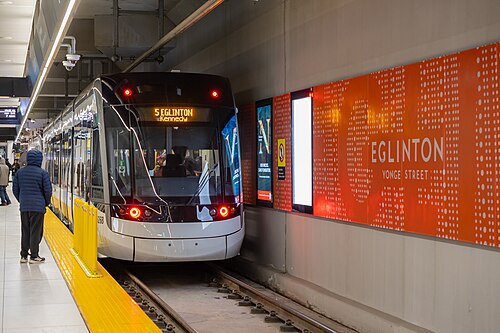
Within days of the line’s opening, Mayor Olivia Chow promised to address the issue of Transit Signal Priority (TSP). The equipment for TSP was installed, and is also implemented at many other intersections across the city, although not fully utilized and the city’s reluctance to implement in on the surface section of the Eglinton LRT is something Transport Action has been concerned about, so we will be very pleased if the policy is finally changed and TSP used to its true potential across the city, with benefits to streetcar and bus passengers as well as both LRTs once Eglinton opens, now expected in the early spring.
Even with these issues, the line is certain to be a success and to facilitate additional housing and economic activity along the route, and hopefully it is just the start of delivering the massive amount of additional public transport the region needs. It is vital that rather than wringing hands over the difficulties associated with launching these LRT projects, after many years of underinvestment, the Ontario government continue steady investment so that the industry capacity and engineering skills base developed for them is not dissipated, and the return of experience is fed back into new ensuring the success of projects like the Hamilton LRT and Eglinton East.
We also hope to see Finch West to extended beyond Humber College to the new Woodbine GO station and the airport.
The continued expansion of Greater Toronto’s rapid transit system has resulted in numerous cases where station names are problematic, including interchange stations having two names, or cases where the names of stations are duplicated elsewhere in the system. This causes confusion for residents and visitors.
Transport Action Ontario, together with More Transit Southern Ontario (mtso) and TTCRiders have submitted a paper to Metrolinx identifying most of the problematic names and providing renaming recommendations. The paper will be reviewed by Metrolinx staff.
You must be logged in to post a comment.